
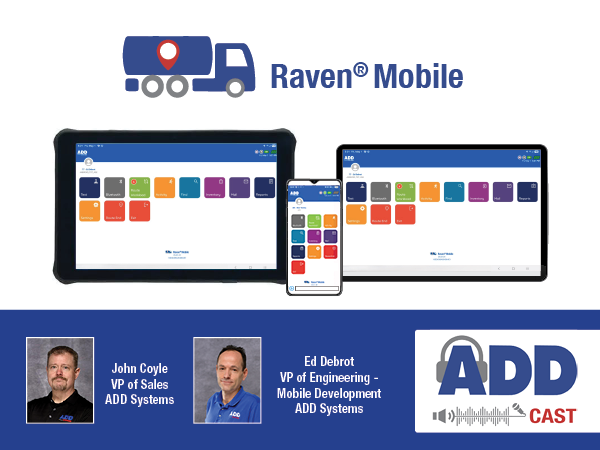
ADD Systems’ Ed Debrot, Vice President of Engineering – Mobile Development, and John Coyle, Vice President of Sales, discuss the introduction of Raven Android. They discuss the Android hardware choices available for the end user, how Raven Windows stands alongside Raven Android as a strong option, and other new mobile technologies that help make operations smoother and more efficient.
You can subscribe to the ADDcast at any of the following locations, or read the transcript below.
Apple Podcasts / iTunes: https://podcasts.apple.com/us/podcast/add-systems-addcast/id1604865113
Spotify: https://open.spotify.com/show/1atj72i5AnIwTJDBFD9DzX
Amazon / Audible: https://music.amazon.com/podcasts/df7c9f4a-8a3f-431f-8787-50eee85b2bcd
Castbox: https://castbox.fm/channel/id4744519?country=us
You can also search “ADD Systems” wherever you listen to your favorite podcasts!
Brian Cohen: Welcome to ADDcast. I’m ADD Systems’ Multimedia Specialist, Brian Cohen. Raven Mobile is ADD Systems’ fuel delivery operations solution, and today we’re talking about what’s new, why ADD is introducing Raven Android, and what customers should be thinking about as they plan for the future. Joining me to discuss those very topics are Ed Debrot, Vice President of Engineering – Mobile Development, and John Coyle, Vice President of Sales at ADD Systems. Gentlemen, thank you so much for joining me today.
John Coyle: Our pleasure, Brian.
Ed Debrot: Thank you, Brian.
Brian: John, over the last few years, there have been dozens of Raven releases and hundreds of enhancements. What’s driving the need for so much innovation in mobile delivery technology right now?
John: Well, it’s really nothing new here, Brian. I think all of our products, including Raven, receive enhancements every year. In fact, it’s that commitment to continuously evolving and meeting our customers’ changing needs that keeps ADD Systems ahead of the competition. Across our products, we’ve added over 1000 enhancements a year to the entire ADD family. Specifically about Raven is a mobile product is only as good as the customers who are able to use it, and they’re trying to do more with that product today than they’ve ever done before. They want to connect with their clients. They want to be able to give up-to-date live information. And those are some of the real recent enhancements we’ve made that, over the last couple of years, have really propelled this product that’s been around since 1995 to be an industry leader today, just as much as it was back in 1995.
Brian: Now, Ed, bringing you into the conversation. From an engineering perspective, what were the biggest goals your team wanted to achieve with this next generation of Raven?
Ed: Well, Brian, I’d have to say it wouldn’t be an understatement to say that my whole team was universally excited to work on what is essentially a brand-new product. This means a new design, a new architecture, and making use of the latest development tools. We didn’t exactly start from scratch, but we were able to take our existing knowledge and apply it to the new implementation of Raven. So we had five primary goals: advanced diagnostics and support, ease of deployment and updates, a secure implementation, seamless integration into the Android operating system, and seamless integration into existing Raven deployments.
Brian: John, what’s the one improvement that you think is going to have the biggest day-to-day impact on customer operations?
John: That’s a great question, Brian. The biggest day-to-day impact, I think, is going to be that seamless integration to existing Raven deployments that Ed spoke about. But in general, I think the product is just further enhanced as we allow clients to communicate with their customers, building on the confirmation emails and the text messaging that we’ve been able to do with the product, and adding over the last couple of years. Continuing to advance that Communications module. It allows our clients to keep their customers informed, and an informed customer is always a happy customer. ADD delivers for its clients, allowing them to connect and communicate with their customers much in the same way as those customers are interacting with companies like Amazon. So I think that combination of being able to have a mixed fleet that’s going to be partially Windows and partially Android, and still be able to communicate all seamlessly in the same way out to your clients is what’s got our customers most excited.
Brian: And if someone’s using an older Raven product or Raven Windows, can you use Raven Android simultaneously along with the other devices?
Ed: Yeah, I mean, we actually have handhelds, which are like 25 years old, working with the Android tablets.
John: Yeah, if we didn’t do that, it’d be very difficult to roll the product out for clients to have to flip all their trucks because the truck has to be worked on and has to be modified to switch the tablets, and to be able to do all the trucks in one day like that is, depending on the size of your fleet, is almost impossible. Two trucks, you know, it’s not such a big deal. But if you got 100 trucks out there and you got to bring them all off the road, and you got to put a new mount in, it all takes time. So being able to do the dual rollout and have both products running simultaneously is really key.
Brian: Now, Ed, launching Raven Android is clearly one of the headline announcements that came from the 2026 Business Tech Conference. Why was now the right time to make that move?
Ed: Funny that you put it that way. If you asked John, he’d say the right time would have been a couple of years earlier, but the truth is that it was a good time for us. We recently increased our staff and have some top-notch people working in the Mobile group, and the development tools have matured enough that we can do things that only a few short years ago were not possible. For example, what we’ve developed can target any number of Android devices, and not just tablets, but also phones. Out of the same code set, we expect to be able to target Windows tablets as well. So we technically will be able to introduce a new Windows Raven version sometime in the future that looks and behaves very much like the Raven Android product. The exact time frame for that is undecided, but something we’re looking at for the future.
Brian: Excellent. John, what are customers telling you about Android? What excites them the most when they actually see it for the first time in action?
John: That’s a good question. The ability to add another operating system to Raven just makes the industry-leading product that much better. So, really, customers are excited about choice. I think first and foremost, with the launch of the Android offering, we’re providing clients with a good, better, best option story when it comes to the hardware they can run it on. We’re offering a fully rugged tablet, a semi-rugged tablet, and customers can do what we call BYOD, or bring your own device. So whether they want to get something that’s going to be super durable and last 10 years, or they want to get the cheapest item on the market, maybe it’s even going to be free with their local cell phone carrier. The choice is the thing that they’re most excited about. Each client that we work with has their own idea of what they really need. Some really love rugged and love having a piece that’s going to last and be durable in the truck, you know, from day one through the next 10 years. Others are really excited about being able to say, as Ed said, with a phone option now, they already give a driver a phone. Now they can have one device instead of two devices in the truck, and it’s going to cut back on their costs over the hardware itself. But, ultimately, it’s easier for the driver because he’s only got to look at one piece, one device. So that choice has really got our clients most excited about this new change.
Brian: Now I want to continue on that point, John, because many companies are running Raven on Windows today, so what are some of the enhancements customers can take advantage of immediately without having to change platforms?
John: Well, yeah, Brian. As we said before, we are adding enhancements to all of our products every year, and the Raven Windows product is not going anywhere. In fact, we’ve got devices out there that are fully rugged Windows devices that we expect to last the next 10 years because that’s what we’ve seen with this product over the last 15 years. So great durability, and our clients are going to be able to take advantage of that. With each new enhancement that we bring to the market, whether it be in our Windows platform or our Android platform, the goal is that those Android pieces that are new will also be available in Windows. We’re going to continue to support that. That means clients don’t have to change. They can continue to run the system they’re most comfortable with and the system that their drivers know. So that, number one, I think, is really, really important. You know, if we look at some of the enhancements that we put out more recently, working with Sygic, our routing partner for turn-by- turn directions, in the last year, we’ve been able to offer real-time traffic, and in addition to the routing of turn-by-turn directions, so now the drivers can actually get changed routes based on what’s going on in the market. You know, nobody can predict what’s going to happen on the road today. If you’re driving down the road, you see amazing things and crazy things happening all the time. Well, that affects your drivers. So by having real-time traffic updates, those drivers’ routes can be changed on the fly to make sure that the driver is getting to that route and that location that they need to get to most efficiently and as fast as possible. Those are cost savings. Anytime we can reduce miles, we’re saving cost. Anytime we can reduce time, we’re saving cost. So the addition of the real-time traffic to an already robust Sygic real-time routing turn-by-turn direction program with truck profiles just makes that whole experience much easier for the drivers and our customers. And again, the pickup that they’re getting is an enhancement in efficiency, and efficiency enhancements drive dollars to the bottom line.
Brian: Now, Ed, from a developmental standpoint, should customers view Android as a replacement for Windows?
Ed: No, that wouldn’t be correct. I don’t look at Raven Android as replacing Raven Windows. We will still be supporting Raven Windows 100 percent and have no plans to abandon it. As I mentioned earlier, we may even target Windows out of the new Raven Android development environment. This is more of a development goal to reintegrate our codebase so as to minimize duplication of work.
Brian: Excellent. And sticking with you, Ed, for the next question here. One of the themes that was discussed throughout the BTC was making Raven deployment support and security simpler. What improvements are you most excited about in those particular areas?
Ed: Well, I can tell you there is little that makes our internal staff happier, at least in terms of Raven, than the fact that ADD Systems will no longer require customer tablets in-house for configuration. ADD Systems does not need customer tablets in-house ever. This is a win for ADD Systems and customers. Of course, there are many things I’m excited about. The new onboarding concept, where every tablet has to be registered to ADD Security in order for it to communicate with the back-office servers, and that registration can be revoked at any time. In the support area, we can now grab tablet logs on demand. In the initial pilot, this has proven to be a great time saver for both our support and development staff. The result is that we can diagnose problems much sooner than we’ve done so in the past.
Brian: So, Ed, how do features like onboarding, remote management, Bluetooth diagnostics, and Intune support help both IT teams and field users?
Ed: Well, as I mentioned, the onboarding process means that only devices that have been registered into the system can communicate with the back-office servers. Now when we’re asked, “What happens if my tablet is lost. Can I disable it?” We have a good answer, and the answer is now yes, you can disable your tablet, and this can be done through ADD Security. Introducing Bluetooth is a nice addition to the feature set of Raven, but adding Bluetooth can create issues if you don’t have the proper tools to diagnose those issues. We believe we’ve added that to the Raven Android application, and the success of our initial pilot has proven that to be true. For those that don’t know, Intune is a Microsoft product that can be used to manage your remote fleet. It could be any device – tablets, phones, PCs, whatever – and Raven Android can tap into that product. The use of Intune has been a game changer for those customers who are already using Intune to manage their remote devices. With Intune, we can now roll out updates into a customer’s private store rather than sending application installers to their system for the update. But for those customers who don’t use Intune, we will still support the legacy method, and it’s always worked fine for us, but now we have another tool in our belt that customers can take advantage of.
Brian: Now, Ed, you also previewed something called Raven Live, which gives Office users real-time visibility into their fleet activity. Where does that fit into the bigger vision of Raven as we move into the next few years?
Ed: Raven Live started out as a means of monitoring the rollout of Raven Android devices for the initial pilot. Raven Live proved invaluable for the success of that rollout. We were able to monitor application versions and driver progression throughout the day. We could see every tablet in use on a map that included all drivers, and we could even drill down on any one driver for shift details, all from our phones. So when I was on site during the initial pilot, the customer had a driver who had an issue, and the driver was about an hour away. So they gave me the address, and I drove there, and it was a road in the middle of nowhere. And I spotted the driver and pulled over. It was at that time that it dawned on me that with Raven Live, I should have been able to tap on his driver icon and launch a navigation app for driving directions to get his location. I made this request to my team, and not long after that, a new feature was born. So not only was Raven Live growing in functionality, but my team was experimenting with new features that we’ve also been able to add to the Raven Android app.
Brian: Now, John, if we’re sitting together at the BTC in 2029, what do you think customers will say is the most important change that started with Raven Mobile in 2026?
John: By the time the next BTC rolls around, I think we’ll hear that customers are appreciating the choices that we’ve given them. Having multiple choices and multiple options on hardware really, again, puts it in our customers’ hands, which is something we like to do. I think for some of those customers, they’re going to talk about how much money they’ve saved on that hardware when they look at the fleet and being able to buy a bring-your-own device or leveraging the drivers’ phones that they already have in the cab. For others, I think they’re going to want to talk about the efficiency gains and what Ravens really brought to their company. You know, we had one client who always swore to me they were the best drivers, and they didn’t need mobile technology. And when they had some management changes, their management decided to put Raven in. That company saw a 33% improvement in the first few months of their delivery efficiency, and yet they considered themselves one of the best in the industry before Raven. So I think we’re going to continue to see that clients are going to continue to be able to move the bar forward, make more efficient deliveries, and, ultimately, drive more profits into their company, regardless of which hardware choice they have. But the fact that they do have a choice is something that I know that they’re still going to be very excited about three years from now, as much as they are today.
Brian: Now, Ed, for you looking ahead, what are you personally most excited about that’s coming next for Raven Mobile?
Ed: Really, I am excited to just complete the checklist we have to port all the existing functionality of Raven Windows to Raven Android, and we’re just about there. In the next few months, we will be completing the Gas Check module and the Raven Wholesale module, which will leave us just about 100% complete with our feature development. At the same time, though, we are enhancing our Raven Windows product with new features, which will also be implemented in Raven Android.
Brian: John, why should a customer start planning for Raven Android today versus in the future?
John: Well, I think it really comes down to if they’re an existing Raven client, where are they at with their hardware? The hardware only has, you know, a given lifespan, depending on what it is, whether it’s rugged or non-rugged. That lifespan could be anywhere from two years to 10. But if they’re getting to the point where they’re looking at possibly having to replace hardware, it’s a good time to look at the options. And so, that might be a time where they like to say, maybe it’s time I move from Windows to Android because I can use the phone and take advantage of that functionality. From a feature set, the goal is that the products will be continually identical and offer the same level of features as we move forward. So it really is about customer choice. As I talk with clients, there are some that, you know, have an Apple phone and they love Apple. Others are Android all the way, and they want to put every piece of technology on Android. And then for some, the fact that their drivers have been using a Windows tablet for 10 years, they want to continue with that because of the familiarity it has with their drivers. You know, training on something new, even though the product is pretty much the same, it’s different, slightly different. Little layouts are different. So again, that’s something that choice is what our customers are going to be most excited about. But if they’re thinking about Android because they’re getting to that point with hardware and they want to look at it, then it’s really coming down to starting to look at which of those hardware choices is the right one for them, and then how will they phase out that rollout? Will they look to change the entire fleet at one time, or roll it out as a few trucks at a time, which is really how the product was designed? It was designed to work in concert with the Windows product, so that the clients could take their time rolling it out, make sure that they were comfortable, and, you know, make sure they have all that productivity in the field that they expect.
Brian: John, if a customer is interested in Android, how do they move forward with that?
John: Well, Brian, your first move is to talk to your ADD Systems Account Manager. They’ll do the work to take a look at your systems and analyze all the necessary pieces of the puzzle, and they’ll discuss with you the benefits of maybe moving to an Android product versus staying on the Windows platforms you are on today. And again, when we talk about the benefits of moving to Android, we’ve got a fully rugged option, we’ve got a semi-rugged option, and we’ve got a bring-your-own-device option. So three different price points, with each offering a unique set of criteria or durability for each dollar that you spend. Ultimately, in life, you get what you pay for. So if you’re willing to make the investment in rugged, you’re going to have a device that’s extremely durable, and it’s going to last you a long time. If you are looking for the cheapest option because you’re just stepping in and you want to have reduced costs, well, we’ve got that option, too. So really, finding the right size for your company is that first step, and your ADD Systems Account Manager will be able to help you with that.
Brian: Well, gentlemen, I appreciate you both taking the time to speak with me today.
Ed: Thank you, Brian.
John: Thank you, Brian.
Brian: And to those listening, to keep up with the latest happenings at ADD Systems, visit addsys.com/blog or connect with us on social media by following ADD Systems on LinkedIn, Facebook, Instagram, or X. If you have any questions about ADDcast, feel free to reach out to us at addcast@addsys.com. Thanks for listening, and have a great day.


Leave a Reply