
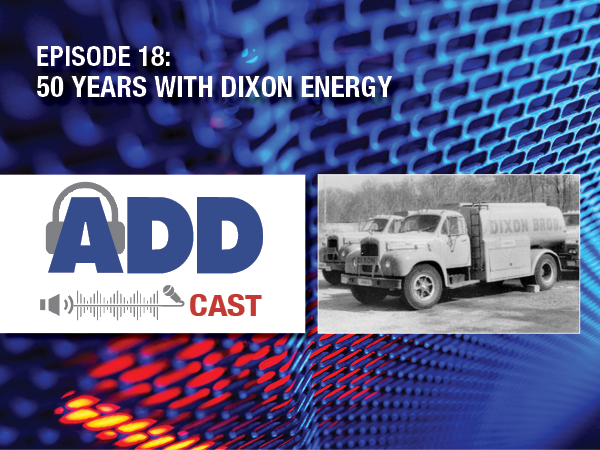
Sally Pierson and David Levitt of Dixon Energy join Brian Cohen, ADD Systems Multimedia Specialist and host of ADDcast, to discuss: the partnership between Dixon Energy and ADD Systems across a span of five decades; the relationships that were built with different ADD employees over the years; and how ADD Systems software functionality has helped improve Dixon’s processes.
You can subscribe to the ADDcast at any of the following locations, or read the transcript below.
Apple Podcasts / iTunes: https://podcasts.apple.com/us/podcast/add-systems-addcast/id1604865113
Spotify: https://open.spotify.com/show/1atj72i5AnIwTJDBFD9DzX
Amazon / Audible: https://music.amazon.com/podcasts/df7c9f4a-8a3f-431f-8787-50eee85b2bcd
Castbox: https://castbox.fm/channel/id4744519?country=us
You can also search “ADD Systems” wherever you listen to your favorite podcasts!
Brian Cohen: Welcome to ADDcast. I’m Multimedia Specialist Brian Cohen, and I’m joined today by Sally Pierson and David Levitt of Dixon Energy. Welcome.
Sally Pierson: Hello.
David Levitt: Good to be here.
Brian: First, I’d like to thank you both for joining us today and being representatives of ADD Systems’ first client. David, can you tell us a little bit about your role throughout the years?
David: I was introduced to the ADD System, and, in the Dixon oil company’s offices in Boonton, when Bruce Bott was still developing it on a PDP-8. At that time, we thought the whole thing didn’t make any sense. Nobody had computers in their office, and we had no idea what they could do. And so, we resisted the opportunity to become an ADD’s customer. I think at the time, the only customer was probably Bill Dixon. But, over the years, we learned the silliness of that decision, and we acquired the services of the ADD Systems to run our oil business, take care of all those chores that we used to do manually, like report gas and customers, using index cards, and printing tickets, you know, manually. And as that system continued to grow, and as we continued to grow, we adopted almost all of their software for the customer service parts of thing, the service department, the oil portion of it, forecasting, back office, and it has grown with us and provides all the services we need.
Brian: Excellent. Sally, can you tell us a little bit about your role?
Sally: Yeah! I am the Vice President of Dixon Energy, and I am also a Pierson of the JW Pierson company in East Orange, New Jersey. And my family purchased Dixon Energy in the early 80s. And my sister, Jennifer, and I run the company to this day.
Brian: So, Sally, you just mentioned about the acquisition in the early 80s. Can you talk about the relationship that is between the two entities because of that acquisition?
Sally: Sure. I mean, it’s the Pierson family, separate company, but the same ownership. And essentially, JW Pierson company is in the eastern portion, northern portion of the state and Dixon Energy is in the western portion of the state. So, together, we are combining to have a good stake in the northern portion of New Jersey. We do heating oil and propane and HVAC. And that’s pretty much it.
Brian: So, there’s been a partnership between Dixon Energy and ADD Systems going on now across a span of five decades. Can you talk about that, and how, over 50 years, the two companies have worked together?
David: Sure. Generally speaking, this oil company is not looking to be a first adopter of some kind of technology that we are not coupled with, or we’re not familiar with. And so, when we started with ADD Systems, we had some concerns as to whether or not this thing could do what we needed it to do and would make our lives better and make our customer relationships better and make us more efficient, etcetera. And the more we used it, the more we discovered that, in fact, all of that was true. So, we did adopt different portions of the software that’s offered, but gradually. We don’t want to jump in there and do too much too soon. And so, the good news is that ADD’s training, and their support, has made that all possible. We took baby steps, moved along slowly. But I think at this point, we’ve adopted so much of their software, we literally can’t function if the system were to go down. We can’t answer a phone call. We have no idea who the customers are, what they are, what they want, what their needs are. We have absolutely nothing; we could do nothing here without ADDs. So, we have obviously gone, put our faith at 100%. And we’ve really not been disappointed. It continues to function beautifully, and it continues to develop as new technology comes available. You know, we might get our feet wet first before we jump in, but it’s there.
Brian: So, David, when you work with a company for five decades, obviously, relationships are inevitably built with different employees through the ADD Systems team. Can you talk about some of the experiences that you’ve had with ADD employees over the years, be it in implementation, customer service, or, at the moment, when you take on another piece of the ADD Systems’ suite?
David: Interesting. I think with almost any vendor, you develop relationships with those employees who we feel do a better job. They either know the software better, or they better understand our questions or the type of company we are. And you’ve got a structure that allows us to do that. I guess you have a company culture that allows people to have those kinds of relationships. I would share with you, Al Friedman was a partner there many years ago. And it’s just one of these things that happened that you’ll never forget. And we did a lot of stuff entirely in our own office, like taking backups and making modifications to files. At that time, you did not do that there, or you didn’t support, or you anticipate having somebody in that office who could do such things. We didn’t have a support network large enough to handle those things. So, I, unfortunately, had the capability of deleting files, and I one time deleted our data. I had that moment, went into nightmares. End of the day, I was doing a backup and I did something really foolish. And I actually went to a panic. I thought the whole thing was shot. And I get a hold of Al, who called me back and was able, miraculously, to restore the deleted files by writing code that would find them. It’s that kind of support. I don’t know how you cannot value that, more importantly, than almost anything else. You can’t get that everywhere. So, I had that experience early on. And Al and I became fishing buddies and I love him.
Brian: Well, Sally, I’d like to pose the same question to you. Can you talk about some of your experiences with ADD employees over the years?
Sally: A good example of a good company, and one that has employees that have been there for a long time. And people that you can call upon, and as David said, have the experience and the knowledge of your company and your business, and can just help you or sell you the right products that you really need because they know you so well. And that relationship has fostered a lot of goodwill between all of our company. And, you know, it’s been an overall, you know, there’s always a little clap with anybody, but overall, I’d say it’s been an excellent relationship.
Brian: Now, David, can you maybe provide a few examples of how ADD Systems software functionality has helped improve some processes at Dixon?
David: Well, the most fundamental to an oil company is delivering oil efficiently. In the old days, you know, we calculated how many degree days you needed to wait between these two deliveries in order to get an optimum delivery. It was more or less a fixed number, you know, you did the multiplication. I got K-factor times the optimum delivery. That’s how many degree days I’ll wait and everything, x number of degree days I’ll wait to produce that payment. So, the thinking always was, “When is this guy due by degree day?” Kind of like, think of it as a date. Is he due at 100 degree days, 1000 degree days, and when is he due? As that degree day approaches, I’m going to pull that ticket up, make that delivery. ADD Systems instituted a system of wanting delivery tickets as a percentage of tank. . . The percentage concept is a wonderful enhancement. It allows us to go early or late and hit the number of gallons per tank that we wanted to hit or that we consider reasonable or efficient or profitable. So, that whole concept, I don’t know existed in this industry before ADD provided it in their software. To this day, we do not ever send out customers based on their degree day due in the calculation, but we send it out by the size of delivery we want to make in that tank based on today. If I go out today, I want to hit 200 gallons. It may not be due for a month, but I’ll deliver today because he could take that today. That’s an enhancement that I know provides us enormously more efficiency than we ever had. You had to go looking for more than that. Yeah, sure. Throw in Pegasus as your software for sending out service techs. So, instead of pushing around lots of little pieces of paper, having service techs come in with both filled-out forms in hand writing and then somebody going through them, billing them or not filling them, entering those into some kind of filing system so we have a record of what services we did. All of that is gone. But Pegasus, that’s a wonderful enhancement that technology provided that no way we could have done that without a computer without the ADD Systems software.
Brian: Sally, ADD’s software has changed a lot over the years. Can you maybe highlight any specific enhancements or product implementations that you’ve taken advantage of at the company
Sally: Well, I have to say, Windows was a great enhancement and much more user-friendly. And, obviously, Pegasus that we have instituted maybe three years ago perhaps. And currently we are not on Raven, but our sister Pierson company is on Raven and that has been excellent.
Brian: So, this year, ADD Systems is celebrating its 50th anniversary. And being the first company, I know you had a relationship with Bruce Bott way back in the beginning and, as you mentioned, Al Friedman before. Can you talk about something from the beginnings of the company that kind of helped solidify the relationship that has continued through the company to this day?
David: I will share with you just my first exposure to the ADD Systems, and maybe that helped create a closer bond. Jim Pierson and Bill Dixon were close friends, and I was Jimmy’s partner. Bill Dixon called Jimmy and asked him to take a look at something that’s happening in his office, and Jimmy took me along. And we met with Bruce Bott Sr., who was at that time working — he had worked for the Dixon company I think as an oil truck driver or something. But at that point, he was working on a PDP-8 old-fashioned deck machine, writing code that would help Bill Dixon run his business more efficiently, oil company, obviously. And it was all in binary and machine language. There were no Windows at the time. This had to be in the early 70s. And Bill had said to Jimmy and I that, “I like this fella. He’s doing a great job. And I’m investing some money with him, help him get a business started to develop a software for the oil industry. And you have any interest?” So, Jimmy asked me what I thought of the thing. Had a little bit of a computer background. I went to college to study computers — didn’t have computer science degree. But, anyway, I thought it was a terrible idea that the guy did not, I didn’t know what the guy was talking about. I didn’t understand half of what he was saying. And I fear if he got hit by a truck tomorrow, that would be the end of his business. And I recommended to Jimmy that we not get too involved. A year or two later, this thing was a viable business, was running beautifully. And I had the chance to have Bill Dixon make fun of me for having refused to get involved. So, we knew Bill Dixon — I mean, I’m sure Bill Dixon and and Bruce Bott, we’ve known. I’ve known Bruce Bott since the days he was still creating this software in his office. And I became close with the, I think his partner, the first guy he brought in to work for him was Al Friedman. I became close with Al Friedman for reasons we already talked about. And so, I think that personal relationship, obviously, for me at least enhanced the, you know, the ease with which I can deal with them, I could call them, I could get out of this house at night when I really messed up that sort of relationship with any vendor. You can’t replace that. In terms of the people that Bruce had the foresight to employ: purely excellent people. Rob Culbertson is phenomenal. He’s not an engineer in the classic sense where you can’t talk to him because we don’t speak in linear language — he doesn’t get it. He’s insightful, intuitive. Dave Comroe, very practical, down-to-earth guy. You want something done, you knew he could do it. And he got it done. Just the quality of the people that you had on staff, at least in the early days when there weren’t all that many people on staff, was just phenomenal. I don’t know who was in charge of hiring, but, boy, you did a great job.
Brian: And now here we are in 2023, and Rob Culbertson and Dave Comroe are still major parts of ADD Systems. And Bruce Bott Jr. is now the president of the company. So, being able to maintain that lineage through the five decades, including the people that have come into the company in later years, hopefully has made the transition with the software across these five decades seamless for you, the people who use the software on a daily basis. Would that be correct?
David: Yeah, that’s absolutely correct. That, you know, that makes it seamless. If you can talk to the same person you’ve talked to for years, and you develop the relationship and trust them and you respect them and their ability and knowledge, then it makes it way easier to transition to something new, something different. That person still understands you, and you still respect that person. That’s a great way to go.
Brian: So, Sally, I’d like to take a look into the proverbial crystal ball, if you will. And what do you see for the future at Dixon Energy as you look 5, 10 years into the future? And where do you see the company growing from here on out?
Sally: Well, it’s an interesting question as we are at a crossroad with our energy plan for the state and the whole electrification issue and the new products, the highly efficient products, and heating and cooling that are coming down the pipe. You know, with the advent of biofuels, we’re looking toward that as our future as we ease out of fossil fuel. And we think that is a very exciting product. And we are looking for the administration to hopefully take a better look at that, as opposed to electrifying the state. We started in building products and construction and coal and went to heating oil, and so this is the next iteration, I guess.
Brian: Well, David and Sally, on behalf of ADD Systems, I would like to thank you going all the way back five decades from this very long and fruitful relationship. And, more importantly, I’d like to thank you both for joining me today on this edition of ADDcast. Thank you guys so much for your time.
David: Thank you for having us.
Sally: Thank you. It was a pleasure.
Brian: And to keep up with the latest happenings at ADD Systems, visit addsys.com/blog or connect with us on social media by following ADD Systems on LinkedIn, Facebook, Instagram, or Twitter. If you have any questions about ADDcast, feel free to reach out to us at addcast@addsys.com. Thanks for listening, and have a great day!


Leave a Reply