
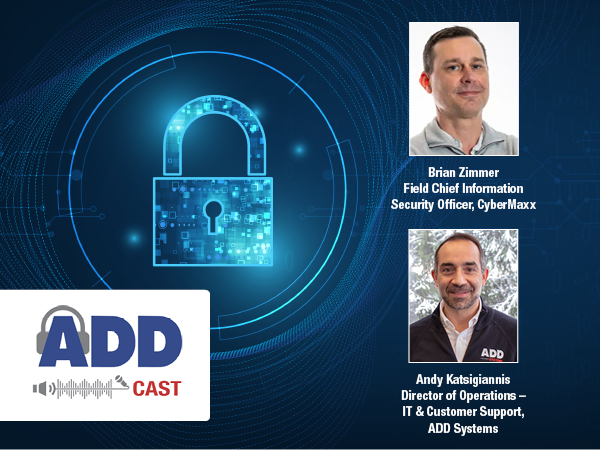
Brian Zimmer, Field Chief Information Security Officer at CyberMaxx, and Andy Katsigiannis, ADD Systems’ Director of IT and Customer Support, discuss cybersecurity strategies for organizations of all sizes. From building a strong security foundation to improving incident response, they discuss how businesses can strengthen resilience and reduce risk. They also examine why preparation, recovery, and continuous improvement are just as important as detection and prevention.
You can subscribe to the ADDcast at any of the following locations, or read the transcript below.
Apple Podcasts / iTunes: https://podcasts.apple.com/us/podcast/add-systems-addcast/id1604865113
Spotify: https://open.spotify.com/show/1atj72i5AnIwTJDBFD9DzX
Amazon / Audible: https://music.amazon.com/podcasts/df7c9f4a-8a3f-431f-8787-50eee85b2bcd
Castbox: https://castbox.fm/channel/id4744519?country=us
You can also search “ADD Systems” wherever you listen to your favorite podcasts!
Brian Cohen: Welcome to ADDcast. I’m ADD Systems Multimedia Specialist Brian Cohen. Joining me today are Brian Zimmer, Field Chief Information Security Officer at CyberMaxx, and Andrew Katsigiannis, Director of Operations – IT and Customer Support at ADD Systems. Gentlemen, thank you both for joining me today.
Brian Zimmer: My pleasure.
Andy Katsigiannis: Hey, Brian.
Brian Cohen: Great to talk to you both. Brian, can you please start by telling us a little bit about CyberMaxx and what your role is there?
Brian Zimmer: Yeah, so two things. So CyberMaxx is a modern MDR company, and for those of you that may not be aware of the acronym soup in cybersecurity that we’re famous for, that is managed detection response. So we are different from a managed services provider or managed security services provider, in that our primary focus is on that detection and response. And as we talk, you’ll hear me talk more about how we do things a little bit differently, especially as it relates to the response element. And then the second part of your question, so my role is under field CISO (Chief Information Security Officer) here, I do have some CISO responsibilities, but primarily my job is to work with our customers, work with our technology advisors, and then also our TSD (trusted signature database) community to make sure they are enabled, but most importantly possibly is to receive and distribute the feedback and the input that we get from our partners and our customers, that is really the lifeblood of the organization.
Brian Cohen: Fantastic. Thank you, Brian. And, Andy, I know you’ve been on ADDcast many times, but for those listening, can you please remind everyone a little bit about your role at the company?
Andy: Sure thing. Thanks for having me. My name is Andy Katsigiannis. I’m the Director of IT and Customer Support at ADD Systems. My role is really split between two major responsibilities. First, what we’re seeing is IT operations, making sure our infrastructure systems, cloud environment, security tools, business applications, etc. remain reliable and secure. The second piece is leading our customer support departments. Customers rely on our support to run critical parts of their business on a day-to-day basis, so availability, security, and responsiveness are all extremely important to us and to them. Over the years, my role has evolved, so IT is no longer just about keeping servers online and fixing technical problems. A large part of our focus is around risk management. Things like Brian mentioned: cybersecurity, access control, monitoring, incident response. These things – we have to stay ahead of these threats instead of reacting. And, again, one of the biggest lessons we’ve learned is that cybersecurity is not just an IT initiative anymore; it’s a business responsibility.
Brian Cohen: Excellent. Thank you, Andy. Now, Brian, I’d first like to thank the CyberMaxx team who joined us this past May at our Business Tech Conference. There, they gave an educational session that focused on making cybersecurity manageable and not fear-based. Can you talk about that a bit more, and what that looks like in practice?
Brian Zimmer: Yeah, there’s a couple things behind that, and I think the larger story is really about maturity, and it’s maturity in us as information security leaders and practitioners, and I think I’m most proud of the fact that now you’re seeing the next generation and younger folks entering the field that are really talking about cybersecurity as a business enabler. It is in lockstep with the business. We are no longer, used to hear this years ago: the doctor knows, right? He talked to the security guys; they’re going to tell you no, can’t do it, don’t want to do it. I’ll tell you a good anecdote, or at least good in my judgment. I used to work for a guy by the name of Steve Ward. Steve Ward was the CISO at TIAA; he’s the CISO at Home Depot. He’s doing a couple of other really interesting things now, but here’s the point: he used to be a Secret Service agent, and he used to say, you have no choice; you can advise the president, but the president is going to do x. Your job is to secure that space and that journey as best as you can, to the best of your abilities. It’s no longer that you can’t do that. And I really took that message from Steve, and I really think that’s the larger message. We’re talking about management of risk vis-à-vis threat actors. And we’re out of the fear game, and I’m really actually proud of where we are as an industry, to be honest with you.
Brian Cohen: So, then, Brian, what do you find are the most common misconceptions business leaders still have when it comes to cybersecurity?
Brian Zimmer: Yeah, I think it’s that, and I might have anticipated your question. I think they still see us as the guys that really love the nerd knobs and love to geek out, and we’re talking about ones and zeros that we don’t understand the business, and worse, that we don’t care about the business, that we’re not really focused on business impact and resiliency, and ultimately uptime. And why do we do uptime? We do uptime so we can do the thing that our organization needs us to do. Is it to provide banking? Is it to provide city services? That’s where I think the misconceptions still lie with a lot of other non-security business leaders. I think the other thing that there may be a misconception, and I think we’ve done a great job, to be honest with you.
Some of them don’t believe that we can get in front of a board of directors and hold that space and speak in business, speak in risk, and, frankly, not embarrass ourselves because probably 20 years ago, we were. Not that I was there, not that I’m guilty.
Brian Cohen: So, Brian, at the presentation, the CyberMaxx team highlighted that the best security strategies start with the basics. Which one or two foundational steps do you think businesses should prioritize first?
Brian Zimmer: Yeah, I think first of all, you have to find a framework. You have to find a playbook, and I don’t think there’s a wrong answer, but you have to find one. Some organizations will connect for a variety of reasons with the CIS (Center for Internet Security) Top 18. Some will be more in line with ISO (International Organization for Standardization); others may be NIST (National Institute of Standards and Technology), but you have to find one. And then the other thing is, with that being your guide, the first place that each of those frameworks says to start is asset inventory: hardware, software. What immediately follows from that is vulnerability management, patching, and ultimately, as my third bonus point, I would say resiliency. I, and a number of folks in the industry, have been really focused on resiliency for about three to four years, give or take. You know, detect, respond, but restore and measure, and I think restoring service to and for the business is an area where we’ve really got to mature as information security practitioners.
Brian Cohen: Thanks, Brian. Now, Andy, I want to bring you into the conversation here. Can you talk about how smaller organizations can realistically implement some of these best practices that we’re talking about today without overwhelming their teams?
Andy: Sure. I’m going to steal some of what Brian just mentioned. I think the biggest thing is understanding that cybersecurity does not necessarily have to be an all-or-nothing approach. So
a lot of smaller organizations hear the word cybersecurity, the term CISO, acronyms, acronyms, acronyms, and immediately think they need a massive budget, a dedicated security team, dozens of new tools. That’s usually where organizations get overwhelmed, from my experience. The reality is we need little wins, right? So, let’s start with multi-factor authentication, simple as that. Because all your users use multi-factor authentication, strong identity and access controls, keeping systems patched, making sure your Windows servers are updated. If you’re running Linux servers, making sure those are updated, having good backups, and most importantly, testing those backups, right? Having teams like Brian and his team monitoring what is happening in and outside of your environment. The other important piece that I see, Brian, is knowing where you need help, and to add on to what Brian just said, most smaller IP teams are already wearing multiple hats on a daily basis, right? You’re managing servers, managing networks, application workflows, users, and now on top of all that, you’re adding the cybersecurity layer, right? That’s where having a partner like a SOC (security operations center) becomes valuable. It gives you additional eyes on your environment 24/7. It’s not replacing your IT team; it’s extending your IT team. For me, ultimately, in closing, the goal is always to make security operational, right? It has to become part of the way you run IT every day, not a separate overwhelming project.
Brian Cohen: Thanks, Andy. Now, Brian, in the session at the Business Tech Conference, it was mentioned that response is more critical than just detection. Can you explain that, and how does having a response team in place change the business impact of a breach?
Brian Zimmer: Yeah, so I will color this answer in the context of what we do at CyberMaxx, which is MDR, managed detection response. If you don’t have an MDR partner, an MSSP (managed security services provider) partner, this is going to be slightly less applicable, but there will be some Venn diagrams happening here, so that’s the setup. When you engage with a partner to do MDR, and I suggest that you do, what invariably happens with a lot of, frankly, our competitors is they are going to find an alert, ingest an alert, so that’s a, you know, something interesting that a system sees. They are then, and here comes the point, going to forward that alert to you. Now, if you are a customer, your initial and immediate response is great – what do I pay you for? So, at CyberMaxx, we like to call those alert forwarders. Now, it is not to say that we are the only ones that do it. I happen to think we do it better than most. The value is time, so attackers value time. The more time they have, the more they can move to what we call action on objectives. So that’s their goal. They’re going to extort you; they are going to make you the victim of ransomware; they are going to exfiltrate your trade secrets. Whatever it is, our goal is to impose costs and time costs and technical costs, skill costs, etc. During that response time, we have to be taking action, and that action on our part is we have to assess what’s going on, we have to assess the impact, we have to then contain that threat actor, so that it doesn’t spread. We then need to move to evict that threat actor, and then we need to ensure that systems are restored to their previous known good state. In that response process, so many MDR providers or MSSPs simply don’t have the tools, the techniques, or the skill to take action on infrastructure, and our rhetorical question to the industry is, then what’s the point? What value are you bringing to me if you are not providing a full response? So that was a long-winded answer. I took you around the block a couple of times. Did that make sense? Did I answer your question?
Brian Cohen: Of course you did. Thank you very much. So, now what I want you to do, because you went around the block a few times, is hopefully you passed a crystal ball here and there when you were on your way, and I’d like you to look into that crystal ball and tell me how you see cybersecurity evolving as we head into the future over the next few years.
Brian Zimmer: I think there are a couple of areas. Number one, it’s this repetition of this theme that we are getting better and better and better at being a business partner. So again, no longer the no factory, no longer, you know, the nerds in the sock, no, like we are a business partner; we can speak in time-bound and metric-driven SLAs (service level agreements), goals, KPIs (key performance indicators), OKRs (objective and key results). Whatever it is, we can speak to the business; we understand the business, and we can present in front of the board with confidence, consistency, and clarity. That’s number one. Number two, I think there is going to be more and more of a focus on resiliency, and one of the things that I’m going to enjoy, if and when we get there – this is a big if and when – is that service partners will be seen more as partners, and we will get more and more out of that gotcha game. You know, why didn’t you see that? You missed that. Now it’s not to say that you let SLAs go by the wayside, not at all. But I think there needs to be, and there will be, a focus on resiliency, especially on recoverability, and to use a phrase again, that focus will be time-bound, metric-driven. We will use things like pen testing, like purple teaming, to measure our effectiveness, not just in detecting and responding to alerts, but recovering in the face of attackers, and I think that’s really important, and I think that is going to be a next step in maturity. The other thing is I think there’s going to be a focus on experience. Now I’m going in a different, maybe HR direction. I think experience is going to be key, especially in the age of AI. I think AI is going to be a great way for us to level up our game and counter what I like to talk about, and a colleague of mine, Vijay Haripal, talked about this recently in a post and a talk that he gave: speed asymmetry. We are going to need to use our expertise, harness AI, and offset the speed asymmetry that attackers impose on us. They are moving faster, they are weaponizing AI, and they are moving to attack us with, at times, industrial scale and speed. We are going to use our experience harnessed with AI to counter that speed asymmetry.
Brian Cohen: So sticking with the topic of AI, I know we were looking into the future with that last question, but can you talk about where AI is most effective today when it comes to cybersecurity?
Brian Zimmer: There’s a couple of areas that I think are really important. I’m trying to think of which order I want to start. So, let’s start with alert coverage. A lot of organizations ingest, or let’s just use the verb “see.” How do they see it? What system do they see it in? It’s not important. They ingest, or they see alerts? What do they do with those alerts? I am aware of a number of organizations that do not see or take action on alerts for weeks. We have threat actors that can move in minutes and seconds to action on objectives, so if you don’t have alert coverage that’s processing alerts, that’s prioritizing, that’s doing something with them at a level-one or a level-two level, not to use that word again, I think you have a problem, and I think that is an area where AI can immediately come in and make a difference and a positive impact. The next one would be enrichment, and what enrichment means is when I take that alert, am I prioritizing it appropriately? Am I making a risk-based decision, both as an agent using the model and as a human? So, you know, is there a known exploitable vulnerability associated with that alert? Is that system that those two things apply to a high business impact system, or is it low business impact? So AI is going to help us make those decisions, and it’s going to help make those decisions faster. Again, we’re talking about speed. Speed is really key here. I think the next area is orchestration and automation. Once we, and of course, I’m speaking agentic, once we really level up our game with what we’re orchestrating, what we’re automating, the agentic flow, it will move faster; it will have more efficacy; it will be more valid. I think the SAT word I’m looking for is veracity, but I didn’t want to use that because I’ll be accused of, you know, being pretentious. I think the other area is GRC (government, risk, and compliance). So much time is spent, I didn’t say wasted, so much time is spent gathering reports, gathering data, gathering metrics bi-directionally. You’re seeing organizations like Vanta really excel in this space, but I think so much of that clerical work is going to be offloaded in the GRC space. The next area is syntax. When you move from system to system to system, language to language to language, there is a learning curve, and you’re assuming your SOC analyst or your security folks can speak the syntax of those systems. AI allows us, and I’ve seen this and lived it. AI allows us to be syntactically neutral. I just made that phrase up. I don’t even know if it made sense, but really, what that means is: am I speaking human language to that system, and then the model is taking the syntax off my plate. I can query Splunk, I can query CrowdStrike, Sentinel One, Elastic, I can query any of these systems, and I can ask it in natural human language to do things. And then I think the third, or whatever number I’m on now, I’m probably on number five. I think reporting metrics and visualization – the ability to quickly and easily take all of the important data that we have and that we’ve gotten from our systems, and put it into relevant, meaningful reports and up our data visualization game, because ultimately, and that may seem innocuous, it may seem very unsexy to security professionals, but this is how we communicate with the business. This is how we show ROI (return on investment); this is how we show that we are doing our jobs. Now, are we doing it well? Are we doing it poorly? Who knows. But that’s how we show the business what we’re up to.
Brian Cohen: Well, Brian, this is all extremely fascinating stuff you’re talking about here, and I’m sure there are some decision-makers listening who are wondering to themselves how a CyberMaxx client would measure the ROI of their security investment. Can you talk about that?
Brian Zimmer: Yeah, I can talk about it now. And I’ve got to do a good job. We’ll let the listeners judge. There are a couple of areas. So one area where we try and get out of the mean time to respond, the mean time to detect game. We really talk about response in the sense of this is how long it took us to contain, evict, and restore service. So that’s the first ROI, or the area where we like to show progress back to the business. So we want to show quantified improvements on, and I know this is going to be a little contradictory, the mean time to detect: are we detecting things faster? The mean time to respond: how long did it take us to recover? Were there business interruptions, and can we show those improvements or failures over a period of time? There’s obviously compliance ROI; there’s insurance impact, so improved insurability, lower premiums, lower retentions, fewer coverage exclusions. So that’s another area, and honestly, that may seem tangential to what we do as an MDR provider, but it is most definitely not. Another area is reduction in critical vulnerabilities, attack paths, privileged risk, and misconfigurations, so that’s a huge area of where we can show return on investment, and I’m trying to think if there are other sexier areas. I think those are the ones I want to hover over for the time being.
Brian Cohen: Okay, and from there I’d like to zoom out a little bit and ask, how do dashboards and reporting help organizations make better decisions?
Brian Zimmer: Yeah, so I might backtrack and merge those a little bit. So I think I would say, how else will we communicate with the business? How will we show the data? How will we show the trending? How will we make – and I keep harping on this phrase. I learned it from – it was reinforced. I shouldn’t say I learned it. I used to work with a guy by the name of Adam Apps, and Adam used to always talk “time-bound, metric-driven.” So let’s hover over another topic. I’m going to throw a shout-out to my friends at Hacker One. Hacker One talks about this return on mitigation. So if I’m a CISO and I’m going to my CIO (Chief Information Officer), or if I’m going to my board and I’m saying I want to engage with Hacker One, they’re going to say, what is your return on investment? And I’m going to say I’m going to give you a return on mitigation, so what revenue did this create? What loss did this prevent? I’m talking about what is this risk that I mitigated, this vulnerability that I mitigated. I want to apply a formula to it, and they do have the formula. I looked it up before I came over here. It’s 3x on return on mitigation. So that equals $3 of mitigated loss for every $1 spent on a found vulnerability, on something that somebody in the Hacker One pantheon, if you will, identified. So that’s the metric. And again, how else am I going to show that to a board? How else am I going to show that back to the business if I don’t have a dashboard and I don’t have reports? Now I’m going to take a pause, and then I’m going to put my MDR pants on. Those reports and those metrics are essential. I need to see what my critical vulnerabilities are. I need to know what my critical alerts are. I need to know how long it’s taking to get to each of those in my dashboard; I need to show improvements over time. I need to know the disposition of a case, and I know this seems really simple. I need to full case logs; I need all of that information, and as a buyer of an MDR solution, I would advise, don’t overlook that. Your partner – and notice I use that word – your partner who’s providing MDR, providing MSSP services, should give you a single pane of glass with which you can see and consume and export all of that information, and that is really, really essential, and it’s a thing that gets overlooked. It should not be overlooked.
Brian Cohen: Now, Andy, Brian is leaving us today with a lot of great information. If there’s one thing from our discussion today that you want listeners to walk away and act on immediately, what would you say that is?
Andy: You expect me to say one thing after all that good stuff that Brian just mentioned. So don’t wait for an incident to figure out your cybersecurity plan. How about that? So a lot of organizations only discover their cyber gaps during an event or an emergency, right? And at that time everything becomes harder. So, cybersecurity is not just about eliminating every risk; that is nearly impossible. It’s about reducing your exposure and also being prepared. Brian, would you agree that the companies that recover well are usually not the ones who have never had an issue, but are the ones that have actually planned ahead and had hard discussions?
Brian Zimmer: Yeah, 100%. And if you go back to the incident response life cycle, what’s the last phase? It’s lessons learned, and to your point, the companies that excel and that do the best at managing risk are the ones that have experienced the bad day, they’ve used their lessons learned, and they’ve improved.
Andy: Stop being reactive, right? You have to start having these conversations with the business, and like you said, nearly mandate.
Brian Cohen: And, Brian, I’d like to ask the same question to you.
Brian Zimmer: Yeah, I think, well, other than what we just violently agreed on, I would say table stakes, as I said earlier. If you’re a business leader and you don’t have a framework at this point – and I should say a security leader – you need to find one. Pick one. It’s okay. Find one. It’s your roadmap. How are you going to get from point A to point B without some basic framework, without some guide? How are you going to track metrics? How are you going to make things? And everybody knows what I’m going to say: time-bound and metric-driven, you have to manage to something, and it has to be a framework. I would say get serious about detection and response, not alert forwarding. I’ll say that in total again: get serious about detection, full detection, including enrichment and response, not alert forwarding. And as a buyer, ask the important questions. What does response mean to you? Are you going to disable tokens? Are you going to rotate credentials? Are you going to apply a firewall rule? What are you going to do, or are you simply going to forward me an alert at 3 am and I have to do something, even though you know I’m an eight-by-five operation. What am I going to do on Saturday at 3 am? That’s your job. So, as a buyer, ask those questions, get serious about response, and hold your MDR partner to it. I think the next place is to focus on restoration, restoration of service. Andy mentioned this. We talk back and forth about practice. Practice what it means to recover, restore service in the face of an adversary. How do you do that? Number one, we just mentioned it. You’re going to focus on those lessons learned as part of the incident lifecycle. Don’t shortcut that last and critical step. Next, you’ve got to harness red teaming and purple teaming. Let’s just call it offense. Google’s Beyond Corp years ago, a lifetime ago, started telling us, let’s stop using pen testing as a vulnerability finding exercise, as a vulnerability management exercise, as a gotcha game, as something we’re doing for compliance. Let’s use it instead to demonstrate how an attacker would attack us. Let’s show the business that we can respond. Let’s show the business that we are prepared for all eventualities again in the face of attackers. We can do tabletops with executives, we can do tabletop exercises with technical staff, we can even incorporate offense into those tabletop exercises, but we’ve got to prepare, and we’ve got to go through these motions before we’re doing it in front of an adversary; that’s the key.
Andy: So you actually mentioned something interesting is that the reps, Brian, getting reps in about restoring your backups is something that I feel a lot of what I’ll call smaller IT organizations miss on, because they wear so many hats, right? They just think, hey, the backups are working, backups are working, never need to passive restore, right? Like anything else in the world, you know. I always tell my son, if you want to be better at basketball, you got to get the reps. If you want to be better at anything, you got to get the reps in. Practice restoring, having these hard discussions about, you know, when you get hit, what do we do, type of thing. Yeah, so yes, I agree with that 100%. I just wanted to reinforce it, too, is practice, practice, practice.
Brian Zimmer: Let’s double down on reinforcing it. This is an area that I’m super passionate about, and it’s interesting because until years ago, until I met folks at Pure Storage, I really wasn’t familiar with this craft. Now, put this together with my time at TIAA; what I learned there is, Andy, to your point, as an industry, we are terrible at this. The numbers don’t lie. The numbers are telling us over a period of 10-plus years that we can restore service about 19 to 40% of the time, and that’s 40% on a good day. So, imagine me going to my CIO or my CEO and saying, yeah, I got you, fam, don’t worry about it, I’ll get you back about 40% of the time. Yeah, Zimmer, are you kidding me? 40% of the time.
Andy: 40% of the time it works every time. I learned that we need to do better as an industry in testing out our resources.
Brian Zimmer: Yeah, it’s wild, too.
Andy: Having that accountability is critical, too, right? Who is responsible for it, right? If you’re overseeing, do you have the people there on a daily basis that are checking your backups, that are just checking to see if they ran, just if they’re running. Not to see if they’re working, not to test out the results or the restore of the results, just to see if the server or the service is even powered on to back up your business needs, right? Like even starting there, and like I said before, little wins, little wins, little wins, right?
Brian Zimmer: It’s interesting, too, because there’s a couple things happening. Number one, if you go into the integrator, the VAR (value at risk) community, a lot of times, they separate those technologies, so the security people aren’t even having that conversation. Next, if you go into many of our customers or organizations, large, medium, or small, the data center team, or the data team, or whatever is responsible for that action, it’s typically not the security team, and that’s really telling. And so when it comes to responsibility, what I’ve noticed in a lot of organizations is that the security organization doesn’t have as much input or isn’t driving this discussion as much as I would have thought that we would have, and I don’t think a lot of people are aware of how bad it is, and I don’t know why that is.
Andy: So, what do you mean by splitting the data center and security team? I own a small business, let’s say, for example. I have a server in the back that’s running my business, essentially, right, Brian, and I have tasked a guy to make sure that, you know, my backups are working. So you’re telling me that the guy that I have tasked to make sure that my backups are working, and to make sure my server is working, and also to make sure that he’s also doing my standard day-to-day business things, he should also do the security items, too, or should he have someone else do it?
Brian Zimmer: I’m saying that if I were the CISO of your organization, or I had a team, that the odds are if I was anything like the rest of the business world or organizations, we would have no visibility into that, we would have very little say, we wouldn’t be tracking metrics around any of those key metrics that you mentioned. So I’m not saying that he or she or they or whomever it is that’s executing it should be part of the security team, per se, but I think if you look at, and I’m sorry to be old and lame here, the CIA Triad: confidentiality, integrity, availability. Well, we’re talking about availability here, and as a CISO, that’s part of my responsibility, but I have somebody that’s helping address availability, and I have very little insight into what this person or this organization is doing. Does that make sense?
Andy: Yeah, yeah, it does to me. It does. You really have to work tightly with your teams. And whether you have those teams internally, then you have to rely on companies like yourself to offer that type of security visibility, to be able to make sure you’re not waking up in the middle of the night with sweats, thinking about whether or not your business has been impacted, because you have 24/7 eyes on there. My security operational team that knows what they’re doing to understand the trends that are going on in the world, right? Because trends are occurring so fast that the trend from yesterday is already legacy, and we are so busy on a day-to-day basis that we cannot rely on and keep up with the trends. We have to make sure that people like yourself and your companies are driving that.
Brian Zimmer: Yeah. I think it’s delightful that we took such a long system restoration detour, which I love. It’s a topic that does not get covered a lot, and I’ll give the listeners another place to go for this, too. Sounil Yu, a guy that I really admire and have followed for years. Sounil Yu talks about this: is this age of recovery, and is the security business emphasis on the business ready to operate in this age of recovery? I would encourage everybody to go read all of Sounil Yu’s work. It’s top notch.
Brian Cohen: Well, gentlemen, I am sure there’s going to be a lot of questions from the listeners after this incredibly fascinating discussion. Brian, if anyone listening has questions about cybersecurity, how can they reach out to you and the team at CyberMaxx?
Brian Zimmer: Yeah, so probably just, you know, plain old email is fine. It’s bzimmer@cybermaxx.com. Happy to have a conversation, especially if you’re looking for an MDR provider. Then I’m doubly happy to have that conversation. I will apply some priorities. Hey, I’m a prospective buyer. Then let’s talk. Yeah, sorry. Got to pay the bills over here.
Andy: This is true.
Brian Cohen: No apologies needed. Brian and Andy, I thank you so much for taking the time to speak with me today.
Andy: Thank you.
Brian Zimmer: My pleasure.
Brian Cohen: To keep up with the latest happenings at ADD Systems, visit addsys.com/blog, or connect with us on social media by following ADD Systems on LinkedIn, Facebook, Instagram, or X. If you have any questions about ADDcast, feel free to reach out to us at addcast@addsys.com. Thanks for listening, and have a great day.


Leave a Reply