
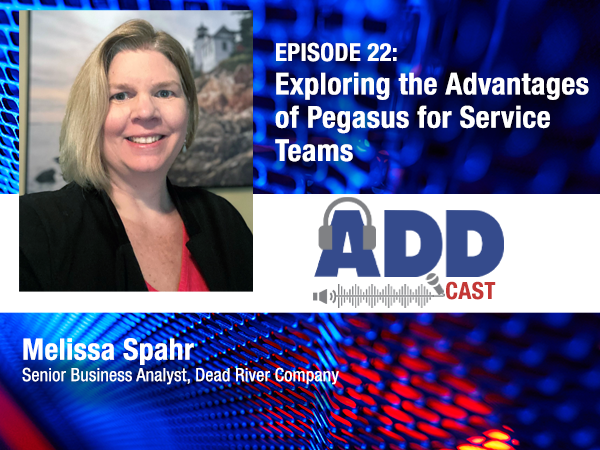
Melissa Spahr, Senior Business Analyst at Dead River Company and Committee Chair of the Pegasus/Service Committee, joins Brian Cohen, ADD Systems Multimedia Specialist and host of ADDcast, to discuss the challenges she’s been able to address with ADD Systems software and the benefits of using Pegasus mobile in Dead River’s service department.
You can subscribe to the ADDcast at any of the following locations, or read the transcript below.
Apple Podcasts / iTunes: https://podcasts.apple.com/us/podcast/add-systems-addcast/id1604865113
Spotify: https://open.spotify.com/show/1atj72i5AnIwTJDBFD9DzX
Amazon / Audible: https://music.amazon.com/podcasts/df7c9f4a-8a3f-431f-8787-50eee85b2bcd
Castbox: https://castbox.fm/channel/id4744519?country=us
You can also search “ADD Systems” wherever you listen to your favorite podcasts!
Brian Cohen: Welcome to ADDcast. I’m ADD Systems Multimedia Specialist Brian Cohen, and I’m joined today by Melissa Spahr, Senior Business Analyst at Dead River Company. Melissa, thank you so much for joining me today.
Melissa Spahr: Well, thank you for having me. Appreciate it, Brian.
Brian: Could you start by telling us a little bit about yourself and your role at Dead River?
Melissa: Sure. I’ve been with Dead River since 2012 as a senior business analyst which means I work in the IT department, and I support ADDs by doing upgrades for different projects. And my roles have been placing the Raven in the truck, Pegasus with our technicians, and doing the system upgrades and enhancements.
Brian: Well, as someone heavily involved with service at Dead River, can you tell us about some of the challenges that you’ve been able to address with ADD Systems’ solutions?
Melissa: Yeah. Our service technicians and our service department, we really wanted to start operating more efficiently. You know, a lot of time, the service department, you always need those key people that have expertise. And we wanted to be able to have the computer system do the work for us and work more efficiently. So we took those key people and created a project team, those key people being technicians and managers, an IT person (myself), and our trainer, and we kind of broke down what their knowledge bases were. And then we looked at ADD Systems. And we took all of that knowledge and information, and we set up the ADD System to do what they wanted it to do. And that’s what is so great about ADDs: you can make it do what your expertise of all your employees know what they have. Because in your different markets, you have different levels of expertise, right? So, you can actually set up your system to do that work for you. Employees, they do, they come, and they go. And so, they have to build up to a specific level throughout time. So why not have the system do it for you so that you can mandate and keep that same level of service for your customers all the time? So that’s the goal that we’re trying to go to: a high level of service for our customers. And that’s what ADDs allows us to do.
Brian: Melissa, what reaction did your back office service team, dispatchers, and service techs have to the addition of Pegasus?
Melissa: Our back office team had a little bit of an adjustment to it because they were used to having stacks of paperwork. So there was a little bit of change management. They’re not having the touch and the feel of the paper. But once they got over the change management of not touching and feeling the paper and realizing that they could actually post real-time, they really started loving the fact that they could actually post same day. They could take all the jobs in the morning and post them in the afternoon. And it was all done. So our billing process sped up considerably. Our dispatchers, on the other hand, our dispatchers loved it right away. There was no adjustment. They realized the weekend call coming in. It saved them hours of researching about where their technicians were nighttime. So that freed up – our first office realized that they had lost a person. And with the efficiency that this has caused, they were able to still maintain their work level with being one person down. So the dispatchers really, really were thankful for this project because it made them so much more efficient. They weren’t taking phone calls because they had the Pegasus tablet in hand. So it really made them much more efficient. They were just very thankful for it. Our technicians adapted much faster than we had anticipated. We did a slow rollout, giving them the work orders at first, and we trained them in Gas Check. And then we gave them equipment and logs. They actually came back and were asking to get rid of the paper. They wanted to adapt much faster than what we were giving them. So they wanted to do tank inspections; they wanted to do anything that they had a piece of paper for. They wanted to ask for a log, ask for a workflow, and they got rid of all the paper. They just love the efficiency of it. So they are completely paperless. They just really enjoy the Pegasus, using the tablet. Our first location that we rolled out, we were able to do one additional service call per technician per day.
Brian: That’s efficiency. What kind of results have you seen with your customer service reps?
Melissa: Our customer service reps, we started with Call Scheduler. So, we built on, we start with Call Scheduler first and then put Pegasus on top of it, which I think you do need to build a foundation. We then allowed our CSRs to book annual tune-ups. So, it gave them the freedom to work with customer calls coming in and not have to transfer their customers a lot. And then, with the addition of having Pegasus, they can actually see information in real-time. So, if they have a call from a customer, they can give them updated information in real-time. So it does allow them to give better customer service now.
Brian: So then, if someone was on the fence about integrating Pegasus into their company, what would you tell them?
Melissa: I think it’s a great way to advance your service department. I would definitely tell them to check into it. For us, it has been a great tool for our service team. Pegasus, a lot of people check different software to find out what works best. With Pegasus, it’s integrated into your solution. And ADD’s is willing to grow with you, and know what your needs are. And for us, and hopefully for others, having a true partner that’s willing to make enhancements and the products that you have as your solution is the way we feel to go. With the enhancement that we had last would be equipment. It has made our life a lot easier. Our technician’s life, our dispatcher’s life, our biller’s life easier, more efficient. If you haven’t seen that new enhancement with the equipment going through in real time, it’s wonderful. They’ve done a great job. And that’s food for thought. I mean, you can keep growing your service department and make it more efficient, and giving technicians tools to have in their hands is important.
Brian: Now let’s pivot and talk about your role as the AUG Service Pegasus Chair. What do you find most beneficial about the group?
Melissa: I think it’s great to talk to people at all different levels. You talk to people, you know, that are just starting out versus people who have been in 20-30 years. And you learn something new every time. And whether it’s learning something new or helping people, it’s very satisfying. You get new ideas to better your company or better yourself or help others. So it’s a great way to make new acquaintances. And to learn more about the product and about how other people are using the software that you may not use the software exactly the same. But it gives you an idea how you could do it differently. And that creates momentum for your business to use it better.
Brian: What are some of the things you’ve gotten from the committee and the AUG in general?
Melissa: I think from the AUG, we’ve got a lot of enhancements. That’s a big question because we’ve done a lot throughout the years. I’ve been with ADDs for 22 years now. So we’ve done a lot throughout the years. There’s been a lot of enhancements. And the committee, you get to know a lot of really great people that you can pull from when you have questions. And just listening to all the different ideas is very helpful. But with the AUG committee, you do work very closely with ADDs. And when ADDs decides to do the enhancements, they do reach back out to you so that you can help create that solution that’s going to be. I think that’s probably the best thing for me is being part of the solution. Right, being able to create it for not only my company but being part of it for others as well.
Brian: And what are some of the future topics the committee plans to cover?
Melissa: We cover anything that anybody would like to cover or have needs. So, I’d like to see us cover warehousing or inventory in the future. I’m sure we will cover Pegasus again, just because we always have new members that come in that’s interested in Pegasus. And if there’s anybody out there that’s interested in Service Call Scheduler, we always are willing to do you a Service Call Scheduler as well. But yeah, we are really open to any topics to do with any service within E3 or Pegasus, or if people want to just talk about how users use the system differently. System setup is also a great one that we like to cover, as well, just to get that information and knowledge out there.
Brian: Melissa, if an ADD User wants to learn more and possibly join the committee, how would they go about doing so?
Melissa: They can email aug@addsys.com and we’ll be happy to reach out to them and sign them up.
Brian: Melissa, thank you so much for taking the time to speak with us today.
Melissa: Well, thank you very much, Brian, for having me. I appreciate that.
Brian: To keep up with the latest happenings at ADD Systems, visit addsys.com/blog or connect with us on social media by following ADD Systems on LinkedIn, Facebook, Instagram, or Twitter. If you have any questions about ADDcast, feel free to reach out to us at addcast@addsys.com. Thanks for listening. Have a great day!


Leave a Reply