
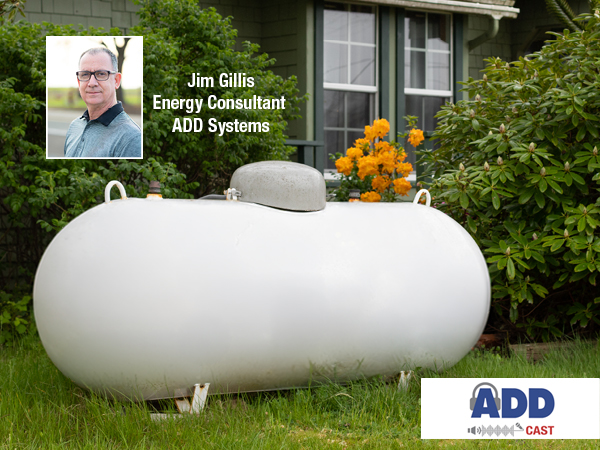
Jim Gillis, ADD Systems Energy Consultant, explains how K-Factors and hot water gallon values influence delivery scheduling and efficiency. He discusses the critical role dispatchers play in maintaining accurate forecast data, reducing runout risk, and keeping delivery operations on track.
You can subscribe to the ADDcast at any of the following locations, or read the transcript below.
Apple Podcasts / iTunes: https://podcasts.apple.com/us/podcast/add-systems-addcast/id1604865113
Spotify: https://open.spotify.com/show/1atj72i5AnIwTJDBFD9DzX
Amazon / Audible: https://music.amazon.com/podcasts/df7c9f4a-8a3f-431f-8787-50eee85b2bcd
Castbox: https://castbox.fm/channel/id4744519?country=us
You can also search “ADD Systems” wherever you listen to your favorite podcasts!
Brian Cohen: Welcome to ADDcast. I’m ADD Systems Multimedia Specialist, Brian Cohen. Today, we’re talking about something that might sound technical at first, but it has a very real impact on delivery efficiency, customer service, and profitability, and that’s forecast values, specifically K-Factors and hot water gallons, and why those numbers matter so much in the propane and home heating fuel business. Joining me today with more on this topic is Jim Gillis, Energy Consultant at ADD Systems, who works closely with fuel dealers, dispatchers, and software users to help them get more value out of their systems and their delivery operations. Always a pleasure to speak with you, Jim.
Jim Gillis: Hey, Brian. Great to be here.
Brian: Well, for someone who’s not familiar with this topic, let’s start with the basics. Jim, if someone’s listening and they don’t work with K-Factor every day, can you start by talking about what it is?
Jim: Yeah, absolutely. A simple way to say it is a K-Factor tells us how fast a customer burns fuel. A low K-Factor means the customer is using fuel faster. A high K-Factor means the customer is using fuel slower. I like to explain it as miles per gallon for a house. Just like a car, some homes use fuel faster than others.
Brian: Okay, so prior to this recording, we were talking about how there seems to be a pattern where larger tanks often have lower K-Factors, and smaller tanks have the opposite, with higher K-Factors. So why is that?
Jim: Well, the pattern makes sense, but the tank size is not causing the K-Factor. The tank size usually tells us what kind of customer it is. A larger tank often means a higher-use customer. They may have a bigger home, more appliances, and more propane demand. Those customers usually burn more fuel, so their K-Factor is low. A small tank often means lighter use: cooking, a fireplace, limited propane use. The customer burns fuel slower, so their K-Factor is usually higher. So the tank is not the reason. The tank is the clue.
Brian: Interesting. So why does all of this matter inside the software? Why should a company care whether the K-Factor or hot water gallon value is accurate?
Jim: Because the software can only forecast well when the values are good. If the K-Factor is wrong, the system may create a ticket too early or too late. Too early means a small delivery, lower profit. Too late, you have a runout risk and unhappy customers. Good forecast values help the company deliver at the right time with a better fill and fewer surprises.
Brian: Now, I’ve heard you talk often about working towards a stronger daily fill average, and that being ideally closer to a 60% fill range. Why is that number such an important target?
Jim: Well, the goal is really to make every delivery count. If you deliver too early, there may not be enough room in the tank. That means fewer gallons per stop. Fewer gallons per stop means a higher delivery cost. Better forecasting helps the dispatcher time the deliveries better. That helps improve the fill averages, driver productivity, route efficiency, and profitability. The stronger fill average is usually a sign that the delivery department is working smarter.
Brian: So then, some people might hear our conversation and think to themselves, “Well, the software should just handle that automatically.” Is that a fair assumption?
Jim: It is. The software is a great tool, but it still needs good information. I say GIGO: garbage in, garbage out. Customers change. They may add appliances. They may use the home differently. They may switch from will call to automatic. Their usage may go up or down. If nobody updates or reviews the forecast values on a regular basis, the system may keep using old data and old information. That is why forecasting is not just a software issue; it needs someone watching it and managing it.
Brian: Jim, in the chance that this feels overwhelming to someone listening, can you talk about how the software does help?
Jim: Yeah, Brian. So when clients originally go live, there are a lot of tables that get set up behind the scenes, and a couple of them are: if the customer gets a delivery and the system thinks that, oh, they’re using a lot more product, it will adjust the K-Factor so that the customer gets a delivery much sooner for the next delivery. And on the flip side, if the customer had a K-Factor of five, but at the time of the delivery, the system said, “Oh, it really should be a 10.” The system’s only going to increase the K-Factor by 10% based on a setting, and that’s where the dispatcher really comes into play here because the dispatcher, after seeing hundreds and hundreds of deliveries, things jump out. And the dispatcher in a situation like that would reach out to the customer and say, “Hey, we noticed your usage increased or decreased,” and then the customer explains, you know, they were on vacation or you know some other event happened, and their usage is going to go back to the same, or yeah, they had a baby and they’re using a lot more product. So the software has the ability to put some safety factors in place to help you. But having that dispatcher jump in and make those adjustments smaller or greater based on information knowledge, or customer communication is really beneficial, but like I say, there’s a lot of tables behind the scenes when clients go live that really should, you know, after you’ve been on the software for a while, you should review them and just see if they still fit, or maybe your business model has changed.
Brian: Well, I guess that brings us right into the dispatcher role then. You’ve said before that a dedicated full-time dispatcher is worth their weight in gold. Why do you feel so strongly about that?
Jim: Because a good dispatcher does so much more than pick tickets. They manage the delivery department every day. They watch tickets. They watch the routes, tank levels, runout risks, zones, weather, driver capacity, and customer patterns. They notice when something doesn’t look right. They see which accounts are being delivered too early. They see which accounts are risky. They see which K-Factors need to be reviewed. A dedicated dispatcher helps turn data into action, and that is why the role is so valuable.
Brian: Okay, so on the flip side of that, what happens when a company doesn’t have someone dedicated to managing this process?
Jim: The company usually becomes much, much more reactive. Tickets get created, but nobody may be asking why. Routes get built, but they may not be efficient. Low fill delivery happens, but nobody is fixing the cause. Runouts happen, but the real issue may not get corrected. A delivery department can be very busy and still not be efficient. That is why someone needs to own the process. They should be asking: are the K-Factors realistic? Are the hot water gallons realistic? Are we delivering too early? Are we getting enough gallons per stop? Are we preventing runouts? Are we improving our fill averages? Those questions need daily attention.
Brian: Now, Jim, I’ve heard you mention that profitability doesn’t happen overnight, especially when it comes to new propane customers. Can you explain that a little more?
Jim: Yes, a new propane customer can cost a lot upfront. There may be a tank, regulator, pigtails, blocks, labor, setup, inspections, service work, and sales costs. Even though it’s a new customer, it may take several years, like maybe three years, maybe eight years, before that account is truly profitable. That’s why good forecasting matters early. If the forecast values are wrong, the company may start making inefficient deliveries right away. The sooner the values are right, the sooner that customer can become more profitable.
Brian: Now, at the top of the episode, we mentioned K-Factor and hot water gallons or HWG, and I’d like to get into that a little bit now. How do hot water gallons fit into this conversation?
Jim: Yeah, the K-Factor helps forecast the heating usage, but not all propane usage is weather-based. Hot water, cooking, fireplaces, and other appliances, they use fuel all year long. That is where the hot water gallons or other than heat matter. When the K-Factor and the hot water gallons are both accurate, the forecast is stronger. The better values, the better delivery timing.
Brian: So, if a company is listening to our conversation today, Jim, and they’re wondering whether their dispatcher is truly managing their account well, what should they look for?
Jim: A good dispatcher is not just working on today’s tickets; they are helping improve tomorrow’s delivery through delivery maintenance. Delivery maintenance is critical. They look at the data and ask, “Does this make sense?” They review unusual K-Factors. They watch small deliveries. They look at runout risks. They pay attention to the tank size, customer usage, will call accounts, zones, and route density. Most importantly, they use the software as a planning tool, not just a ticket tool. The software gives the information; the dispatcher turns it into better decisions.
Brian: Okay, so I want to make this conversation more practical for the listeners. If I’m an owner or a manager listening right now, what’s the first thing I should do?
Jim: Start by reviewing your forecast values through E3 or E360 available reports. Look at the K-Factor and hot water gallons by tank size, division, and customer type. Look for values that do not make sense. Look for small tanks with very low K-Factors; look for large tanks with very high K-Factors. Look for customers getting small deliveries too often. Look for accounts getting too close to a runout. Not every unusual account is wrong, but unusual accounts should be reviewed. Then make sure someone owns the process. That is where a dedicated dispatcher can make a big difference.
Brian: Okay, so the phrase that sticks out to me right there is “someone owns the process.” Would it be fair to say the dispatcher is not just protecting their deliveries, but protecting profit as well?
Jim: Absolutely, absolutely. A good dispatcher protects the customer from running out, but they also protect the company from waste. They help protect gallons per stop, route efficiency, driver productivity, customer service, and profit. They see the delivery operation every single day. They know the routes. They know the customers, the drivers, and the patterns. When you combine that experience with good software data, the operation gets stronger.
Brian: Okay, so then how does better forecasting benefit the day-to-day software user?
Jim: It really just makes the software easier to trust. When the forecast values are good, users can trust the tickets more. They can trust projected delivery dates more. They can plan routes with more confidence. They can spend less time guessing and more time managing. When the users trust the data, they use the system better, and really, that’s the goal.
Brian: Well, Jim, not surprisingly, there’s an awful lot to digest in our conversation today. If you had to leave listeners with one main takeaway, what would that be?
Jim: I think it would be good forecast values are not just numbers in the system: they’re the foundation of better deliveries. A good K-Factor helps the system understand how fast the customer uses fuel. A good hot water gallon value helps the account for year-round usage. A good dispatcher keeps the data clean and manages the exceptions. When those things work together, companies can improve fill averages, reduce runouts, improve routes, and become a lot more profitable. That is why I believe forecasting deserves real attention. And for companies without a dedicated dispatcher, I truly believe they would benefit from having one.
Brian: And, Jim, if somebody has more questions about this, how would they get in touch with you to maybe learn more or see about how you can help them get their K-Factor and hot water gallons headed in the right direction?
Jim: Yeah, they could shoot me an email. They could call me. My email is just gillis@addsys.com, and reach out to me, and we can have a conversation. And I believe I can help them be a lot better.
Brian: Fantastic. Well, Jim, thank you so much for making such a technical subject easy to understand. And as always, thank you for joining me on ADDcast today.
Jim: And thank you. It was all my pleasure.
Brian: And to those listening, to keep up with the latest happenings at ADD Systems, visit addsys.com/blog, or connect with us on social media by following ADD Systems on LinkedIn, Facebook, Instagram, or X. If you have any questions about ADDcast, feel free to reach out to us at addcast@addsys.com. Thanks for listening, and have a great day.


Nancy McDonald says
Jim –
You are fantastic! I really appreciate you putting the role of dispatcher in the spotlight! I feel energized and confident going into another New England winter because of all the training and dedication you and I have put into my role as the Dispatcher/Forecaster. Thank you for your continuous support in making me work smarter not harder! What a wonderful explanation of what really happens on a daily basis. If you haven’t taken Jim’s advice you REALLY should!
Stephanie Gifford says
Great session, Brian and Jim! Everything Jim shared is so spot on—these are real-life facts we’ve learned, adjusted, and truly benefited from over all our years working with him. Thank you for all your help and dedication to making the Maserati work (even if we still occasionally drive it like a Volkswagen!).