
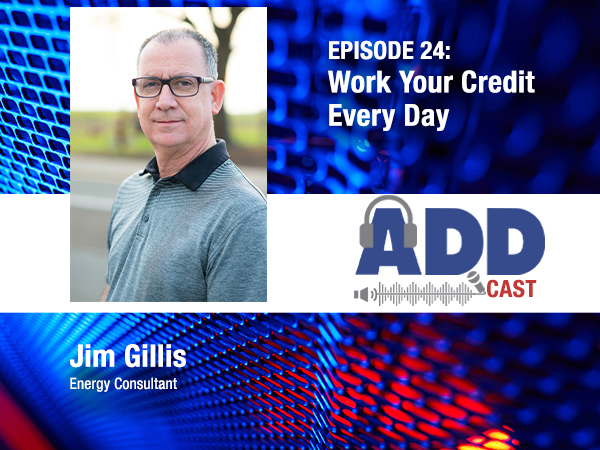
Jim Gillis, Energy Consultant at ADD Systems, joins us to discuss how companies can stay on top of credit during the winter season, including the software tools clients can use to manage credit well & some of the success stories he’s seen.
You can subscribe to the ADDcast at any of the following locations, or read the transcript below.
Apple Podcasts / iTunes: https://podcasts.apple.com/us/podcast/add-systems-addcast/id1604865113
Spotify: https://open.spotify.com/show/1atj72i5AnIwTJDBFD9DzX
Amazon / Audible: https://music.amazon.com/podcasts/df7c9f4a-8a3f-431f-8787-50eee85b2bcd
Castbox: https://castbox.fm/channel/id4744519?country=us
You can also search “ADD Systems” wherever you listen to your favorite podcasts!
Brian Cohen: Welcome to ADDcast. I’m ADD Systems Multimedia Specialist Brian Cohen. And I’m joined today by Jim Gillis, Energy Consultant at ADD Systems. Jim, thank you so much for joining me today.
Jim Gillis: You bet.
Brian: For those who may have missed your last visit to the show, can you please tell us a little bit about your role at ADD Systems?
Jim: Yeah, so I’m a consultant. I used to be one of the trainers when you went from your old software to ADD software, but I’ve kind of evolved into pushing and poking and prodding people to be better users of the software to work smarter, not harder, and make a lot more money. So it’s made me very popular.
Brian: Well, one of the popular topics you cover with clients is credit and collections. Can you tell us why this is such an important topic?
Jim: Yeah, absolutely. So, in my opinion, which doesn’t always count, and I’m okay with that, is that believe that you have to do two things in this industry very, very well: you have to deliver your liquid efficiently, and you have to work your collections efficiently. And a lot of people that I’ve encountered, over the last decade or so, have not been as good as they could have or should have been, in my opinion. And so, I’ve introduced them to applications that they’ve had available to be better in their collections effort.
Brian: And what are some of the software tools clients can use to manage credit well?
Jim: So you have the AR Aging Report, which is the nucleus of this process, which allows you to identify people who have exceeded our client’s credit terms, whether they have $1,000 credit limit, or a 30-day credit limit, they use that application to set those customers up. So, in conjunction with the AR Aging Report, you also have the credit actions which – what did you do when you talked to that customer last? And what is the next thing that you’re going to do in your effort to collect that money? And then from a management or user, you have the ability to use find-blog entries to follow up on those customers that you worked on. So between the AR Aging Report, the intercurrent actions, and the logs, you’re able to really better manage your collections process, and make sure that customers don’t fall through the cracks in those efforts.
Brian: Are there some differences as far as what some companies like to focus on in terms of credit?
Jim: Yeah, so some customers prefer to work their credit a couple of different ways. And one of the ways is some of our clients have customers who they say that they’re allowed to have a 30-day account. And some customers, they have 45 days. Some clients have 90-day account customers. So for like the 90-day account, that might be a customer who is a grower, and they do drying seasonally. Well, those customers don’t make any money until they take their product to market in order to be able to pay our clients. So they can work each of their clients in different groups. But the ability to create that report, save that report makes it much easier for our clients to do the follow up so that they don’t have their customers drop through the cracks and ensure that they reach out to those customers in a timely fashion during their effort to collect monies owed on the account.
Brian: Now, are there specific tools or reports that management typically like to use to keep an eye on credit?
Jim: For sure. From a management position, if I want to identify if my team is doing a good job, or a great job, or they’ve got room for improvement, I can easily run the AR Aging Report in the graph or chart view. And then I can create a pie chart, which displays my collections effort and how much money is in the current 30, 60, 90 day and those are color-coded. Green is current, yellow is 30 days past due, and red is over 120 days. So management can run periodically and it gives them a snapshot into what their position is for that given day. And then so a lot of clients will go in and they’ll make a snapshot or screen capture of their pie chart on a specific day and then three months later, six months later, they’ll go ahead and run another report to compare and see how they’ve done. They also have the ability to run a log report to indicate how many customers have been contacted in a given day or a week or a month. And that’s one of the things that the AR Aging Report allows our clients to see. It tells them exactly how many customers on a daily basis they need to reach out and contact in a month, because in the average month are about 22 working days. So if they take the number of people that are on the report, and they divided by 22, that tells them about how many customers they need to touch each day if they’re to touch all those customers throughout a single month. So between the pie chart and the log report, those are great tools to follow up and see how they’re performing.
Brian: Now, some companies have a credit department, but for others, might it be everybody’s responsibility.
Jim: Absolutely. So one of the things that I try and encourage customers to do when they’re dealing with anything related to credit or collections is to use the credit actions because it makes it easy for our customers to do follow up, and it allows management to have a better indication on how they’re performing in their daily efforts. So whether they’re a company with a complete credit department, or they’re a small company with just a few employees, everybody can use the enter credit actions tool, instead of going in and creating just a free-form text log, which is sometimes difficult to find if you’re trying to navigate the logs in the customer’s display screen.
Brian: Now all over the country, the colder weather is starting to set in. Is it really possible for companies to stay on top of credit during the winter season?
Jim: Absolutely. In order to be effective, customers have to work credit every single day. And if they work credit every single day, it will never get ahead of them. And they will be able to be consistent. And they will encourage their customers to pay in a timely fashion, and that the expectation level is there. So, yeah, when weather sets in and things become very, very busy and the phones are ringing off the hook, it’s still very critical that our customers work their credit every single day, and they don’t let it get behind because once it gets behind, then it’s hard to catch back up. There are only so many hours in a day. So my push to our clients is to encourage and follow up and make sure that they’re comfortable with the tools.
Brian: Would you be able to share some success stories you’ve seen with some of our clients in regards to credit?
Jim: Oh, it’s incredible. It’s very exciting. I have clients when I first met them, and worked in their collections effort. I have one client in particular where they didn’t really reach out to any of their customers until they were over 65 days past due, and I said, “You know, what’s your real policy?” And they said, “Well, if you’re over 30 days, you’re past due.” And so, I think they had about 35% of their money was in current or in the green part of that pie chart. And today, those customers are sitting around 79 to 82% on an average. And so, their ability to make the collections effort easier through their daily practice has been achieved. And I’ve got many other customers who have done the same thing. I have one customer who I was at recently, and they have over $1.9 million in the current bucket. And they have less than half a percent in over 120 days. And that’s just through their due diligence to work their collections on a daily basis. And it’s paying them long-term dividends to work the system and use the applications.
Brian: And if someone would like to get in touch with you with credit-related questions or possibly questions related to anything ADD Systems, how can they do so?
Jim: Yeah, they could reach out and they can use the email. My email is just gillis@addsys.com. And I’ll be more than happy to reach out to them and share the opportunities.
Brian: Well, Jim, thank you so much for taking the time to speak with us today.
Jim: Thank you. It was a pleasure.
Brian: To keep up with the latest happenings at ADD Systems, visit addsys.com/blog or connect with us on social media by following ADD Systems on LinkedIn, Facebook, Instagram, or Twitter/X. If you have any questions about ADDcast, feel free to reach out to us at addcast@addsys.com. Thanks for listening and have a great day!


Leave a Reply